
“Life is not a problem to be solved. Just remember to have something that keeps you busy doing what you love while being surrounded by the people who love you.”
—Héctor García and Francesc Miralles
Do you feel you have a clearly defined purpose? Your purpose may certainly involve your career, raising children, or caring for an elder, all bringing meaning to life. But your purpose can also extend to the unique talents and skills you share. You can find your ikigai, where what you love, what you are good at, what the world needs, and what you can be paid for come together.
Your ikigai is a calling to experience life on a deeper, even spiritual, level. With your ikigai, you add beauty to the world, are engaged in life, and can positively impact others. This article can help you discover your purpose, or your ikigai, and create a more meaningful and joyful life.
What Is Ikigai?
Ikigai (pronounced eye-key-guy) is a Japanese concept commonly defined as your “reason for being.” You can also interpret it as what makes life worth living, or the reason you get up in the morning.
In their book Ikigai: The Japanese Secret to a Long and Happy Life, Héctor García and Francesc Miralles explore the concept of ikigai, discussing how a defined ikigai contributes to life satisfaction, happiness, and meaning.
“Once you discover your ikigai, pursuing it and nurturing it every day will bring meaning to your life,” the authors said. “The moment your life has this purpose, you will achieve a happy state of flow in all you do, like the calligrapher at this canvas or the chef who, after half a century, still prepares sushi for his patrons with love.”
The authors observe that while some people have discovered their ikigai, others are still searching for it, though it naturally resides within them. Surprisingly, ikigai is so central to Japanese culture that the idea of retirement is virtually absent in Japan; instead, people continue to engage in their ikigai as long as they are physically able.
The Four Elements of Ikigai
Ikigai is traditionally understood as anything that gives you a reason for living. In the popular four-circle model shown below, it is represented by four elements: What You Love, What You Are Good At, What the World Needs, and What You Can Be Paid For. When these elements overlap, a person has found the center of the model, representing their ikigai, according to Marc Winn, who introduced the model in 2014 as a practical way to explore one’s ikigai.
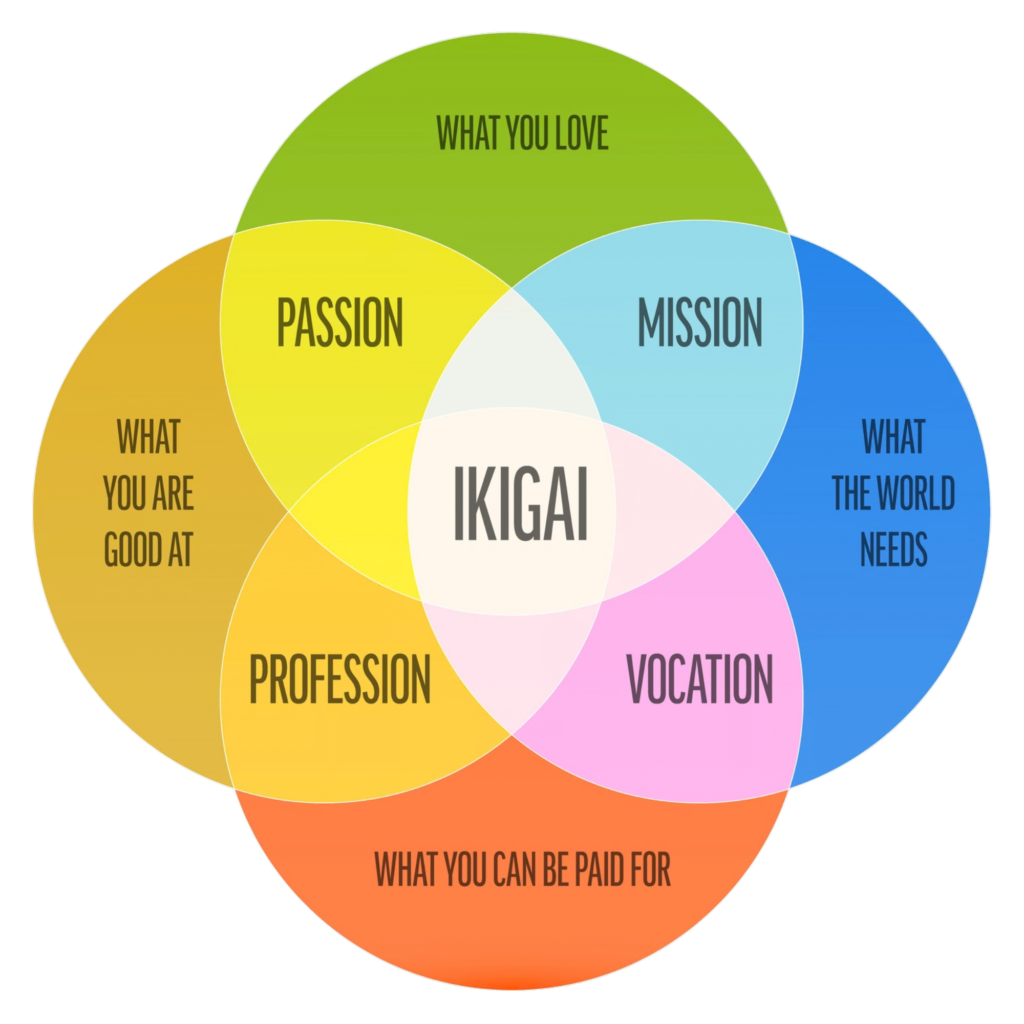
Let’s break down each element of the diagram.
What You Love – We all love to do something, whether it’s baking, taking pictures, solving a problem, or caring for others. One way to determine how much we love something is to notice when we feel blissful while doing it. Psychologist Mihaly Csikszentmihalyi describes these blissful feelings, or ecstasy, as arising from a mental state called “flow,” where time and space disappear, and nothing else matters in the moment. To help identify what you love to do, ask yourself:
- What projects or tasks do I get lost in, losing track of time and space?
- What activities lift my spirits?
- What would I keep doing even if I weren’t paid for it?
What You Are Good At – Typically, we know where our strengths lie. For some, it might be exceptional communication; for others, a gift for negotiating; and for still others, talent for creating. If you’re unsure what you are good at, seek insight by asking family, friends, and co-workers. Simply asking what they think you are good at may help you recognize something you hadn’t realized. Here are some questions to ask them:
- What do you think I am naturally good at?
- What strengths or talents have you seen me use?
- What types of problems or challenges do you think I am especially good at solving?
What the World Needs – When our purpose shines, it becomes a gift to the world. You may inspire others through your creations, such as books, art, or crafts. You may solve pressing problems, such as workplace inefficiencies, through your strategic mind. Or perhaps your organizational skills flourish when you volunteer. The world needs your unique contribution, so ask yourself:
- What problems or challenges would you like to help solve?
- How can your passion help support others or a cause you care about?
- What matters most to you when you think about making a difference in the world?
What You Can Be Paid For – One intention of finding your ikigai is the potential to build a career around it for more fulfilling work. Since we spend so much of our lives working, combining our ikigai with our daily work is a worthy ambition. If you have a difficult boss or a job that doesn’t use your talents and skills, take your ikigai somewhere else.
Why not get paid for what you most enjoy in life? You may not become wealthy, but if you truly enjoy the work and can afford to live on it, money matters less. Ask yourself:
- Which of my talents and skills are people or organizations willing to pay for?
- What type of work would allow me to use more of what I love and do well?
- How could I turn my passion into a service, product, or career opportunity?
How to Discover Your Ikigai
To discover your ikigai, reflect on the questions above, write down your answers, and keep notes of your thoughts. You may also want to experiment with different ideas.
Keep in mind that where passion, mission, vocation, and profession intersect, you may find meaning and joy, fulfill your destiny, and make your mark on the world. Here are some examples of ikigai in practice:
- A writer who loves telling stories (what they love), has a talent for writing (what they are good at), creates work that inspires others (what the world needs), and earns income through books or freelance projects (what they can be paid for).
- A nurse who loves caring for others (what they love), is skilled in providing medical care (what they are good at), addresses the need for compassionate healthcare (what the world needs), and works for a hospital or medical practice (what they can be paid for).
- A small business owner who enjoys helping people (what they love), is skilled at creating useful products or services (what they are good at), meets a need in the community (what the world needs), and earns a living through the business (what they can be paid for).
Set Realistic Expectations
You may have identified three areas, such as what you love, what you are good at, and what the world needs, but are still figuring out how you can get paid for your aspiration. Or perhaps you are getting paid for what you are good at, but it’s not exactly what the world needs.
That’s okay. Think about ways to get paid for what you love while also contributing to the world. It’s all about making progress toward the center, not achieving perfection.
Sustain Ikigai in Everyday Life
In their book Ikigai, authors García and Miralles went on a quest to discover why Ogimi, a village on the island of Okinawa, was home to such a high percentage of 100-year-olds. They found that the reasons for their longevity included strong friendships, a healthy diet, gentle daily movement, and staying active within their community. The authors also found that the villagers practiced their ikigai as part of everyday life.
What a beautiful thing: doing what you love and are good at as much as possible. Getting to this place is a meaningful goal. You’ll know you have found your ikigai when you feel a zest for life, and you look forward to each day. Rest assured that we can all achieve this state. It just may take some thoughtful self-discovery to get there, but it’s well worth our while.
Resources
- Download the worksheet (PDF file) to help you discover your ikigai
- The book: Ikigai: The Japanese Secret to a Long and Happy Life, Hector Gracia and Francesc Miralles
- Take the free Ikigai test to help you discover what your unique strengths are, your ideal career direction, and what gives your life meaning.
- The Ikigai Podcast – Ikigai insights to help you find meaning, purpose and joy in your life.






Leave a Reply