
Enjoy this excerpt from the Joyfulness chapter of Your 12 Inner Strengths, the new book by Stacey Thompson, founder of Virtues for Life.
Laughter can be the fastest route to joy—when we laugh, we forget everything else. All our anxieties melt away in a moment of hilarity. Laughter is also contagious! Just hearing someone laugh uncontrollably can crack us up, too. The sound of a child’s laugh is especially joyous. It’s no wonder there are thousands of YouTube views of babies laughing. Laughter truly is the “best medicine” for our woes.
Norman Cousins, editor-in-chief of the Saturday Review magazine for many years, personally experienced the healing effects of laughter. Diagnosed in 1964 with a painful and potentially life-threatening connective tissue disease, Cousins spent time watching Marx Brothers films, Candid Camera, and having nurses read him humor columns. He found that 10 minutes of belly laughter gave him pain relief and helped him sleep more comfortably.
Along with laughter, generous doses of Vitamin C and medical care, Cousins fully recovered from his condition. He later wrote a groundbreaking book, Anatomy of an Illness as Perceived by the Patient, which explored how our mental state affects health.17
Becoming more mindful, playing more, and creating a beautiful environment can also add joy to our lives.
Becoming More Mindful
In their book Awakening Joy, James Baraz and Shoshana Alexander explain that the practice of mindfulness plays a pivotal role in awakening our joy, writing, “Mindfulness has many benefits, but for our purposes, the most important is that it can help you live a happier life. You can’t make joy or well-being happen, but you can help create the conditions in which those states more naturally arise.”18
The authors echo what the Dalai Lama describes as developing mental immunity, the ability to recognize which thoughts nurture well-being and which cause harm. They explain, “Becoming aware of our habits and the automatic ways we react when we’re confused or upset is the first step to free ourselves from their power.”19 How do we do this, though, when our thoughts and behaviors can be so habitual? First, as the authors affirm, mindfulness helps us unravel these patterns, allowing us to respond with greater clarity.
The 1993 comedy Groundhog Day vividly illustrates this concept, showing how practicing mindfulness can turn a life of frustration into one of joy. In the film, Phil Connors (Bill Murray), a cynical, self-centered television weatherman, reluctantly travels to Punxsutawney, Pennsylvania, to report on the annual Groundhog Day ceremony. He thinks covering the event is beneath his talents and shows contempt for the town and its people.
The night before the ceremony, Phil stays at a bed and breakfast. Oddly, he wakes up at 6:00 a.m., only to discover that he is stuck in a loop, repeatedly reliving Groundhog Day, February 2. He encounters the same people and situations with each day’s repeats, increasing his misery and frustration.
Caught in this endless cycle, Phil begins indulging in reckless behaviors—even crime—because there are no consequences. Feeling depressed and trapped, with seemingly no way out of the time loop, he tries to end his life multiple times by electrocuting himself, stepping in front of a truck, and even driving off a cliff. But the day resets each morning, leaving him right where he began.
Phil eventually tells his producer and potential love interest, Rita (Andie MacDowell) of his plight. Initially skeptical, she believes him after he accurately predicts events throughout the day. She empathetically suggests that the repeating day may be a gift rather than a curse, depending on his perspective.
Over time, Phil sees the truth in Rita’s words and begins to accept his fate. The next day, he wakes up with a new approach, choosing to improve himself and be kinder to people. He brings Rita and the cameraman coffee and pastry, takes piano lessons, saves a man choking in a restaurant, and fixes a flat tire for three older women.As Phil becomes a better man, Rita grows more impressed, and he eventually wins her over.
One morning, the alarm wakes Phil at 6:00 a.m. to the song “I Got You Babe” by Sonny and Cher, as it does every day. But this time, to his joy and surprise, Rita is by his side (for the first time since he began reliving the same day). Now curious, Phil goes to the window to see if the same people are outside. Not one person is out there—he only sees fresh snow blanketing the streets.20
Phil tells Rita with relief, “Today is tomorrow.”21
The movie’s brilliant lesson unfolds when Phil realizes that he cannot change the day, so he chooses to change himself. With this mindful choice, he breaks free from the habitual loops of his thoughts, behaviors, and emotional reactions, transforming his reality. He begins to experience the world as a kind and caring person, and as he changes, his day improves in surprising and joyful ways, and so does his life.
Playing More
Dancing our hearts out, throwing a Frisbee on the beach, and taking a bike ride or nature walk can elevate our spirits. These joyful moments make us feel alive.
I once met someone who found a beautiful way to bring joy into his life. He told me that he loved to dance but couldn’t find any places to go where he could do it. So, he installed a full-size dance floor in his basement and hung a rotating disco ball from the ceiling. Every Saturday night, he and his wife, often joined by friends, transformed their basement into a lively dance party. He brought his joy of dancing into the home!
But play isn’t limited to physical activities. Playful curiosity can be just as thrilling. As we explore and discover our unique interests, we uncover boundless sources of joy. For example, investigating a topic of interest, reading a book series, or exploring a religion or historical event can spark joy. Each day, we look forward to plunging ourselves into our meaningful quest.
The upshot is that we must find more time to play. And if we have kids, they’ll naturally help us be more playful. However we make space for fun, the mental and physical benefits are undeniable, leading to a more joy-filled life.
Creating a Beautiful Environment
Have you ever walked into a room and felt instantly uplifted? Whatever you loved about that room—the sun glowing over an intriguing painting, a particular statue that triggered a pleasant memory, a comfortable old chair—it gave you joy.
Your home might be filled with objects that reflect your personality, such as a well-worn leather chair, cherished antiques, a prominently displayed guitar, a soccer trophy, a book collection, or treasured souvenirs from your travels. If you feel your home lacks the joy you desire, explore ways to make changes. If you like festive white lights, string them around a bookcase. Create a cozy, rugged area with a big chair, a lamp, and a small table, complete with a pillow and blanket for added comfort. Think about items that bring you joy and add them to your home.
In her book Feng Shui for the Soul, Denise Linn captures the importance of being happy with our environment:
Our homes have an enormous impact on our state of mind. They can make us feel as though we are plunging into despair, or they can be uplifting havens of beauty and rejuvenation. I believe the soul yearns for places of sanctuary and balance, ones that provide authentic reminders of what is truly important in life.”22
You don’t have to stop with your home. You can create an enchanted garden in your backyard, mastermind a creative project area, or design a Zen-like office space. Surrounding yourself with what brings out your personality and passions creates an environment where you’ll love to be!
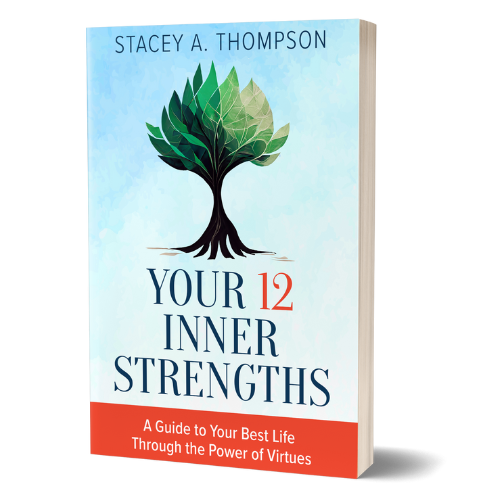
If you’d like to dive deeper into the twelve virtues that help you create your best life, this excerpt is from
Your 12 Inner Strengths: A Guide to Your Best Life Through the Power of Virtues by Stacey Thompson.
You can purchase the paperback or ebook on Amazon.
Also available through other online retailers.
17. Don Colburn, “Norman Cousins, Still Laughing,” The Washington Post, October 21, 1986, https://www.washingtonpost.com/archive/lifestyle/wellness/1986/10/21/
norman-cousins-still-laughing/e17f23cb-3e8c-4f58-b907-2dcd00326e22.
18. James Baraz and Shoshana Alexander, Awakening Joy: 10 Steps to Happiness (Berkeley, CA: Parallax Press, 2012), 32.
19. Baraz and Alexander, Awakening Joy, 35.
20. Groundhog Day, directed by Harold Ramis (Culver City, CA: Columbia Pictures, 1993), Amazon Streaming Video.
21. Ramis, Groundhog Day, 1:36:23.
22. Denise Linn, Feng Shui for the Soul: How to Create a Harmonious Environment That Will Nurture and Sustain You (Carlsbad, CA: Hay House, 2000), 14.






Leave a Reply